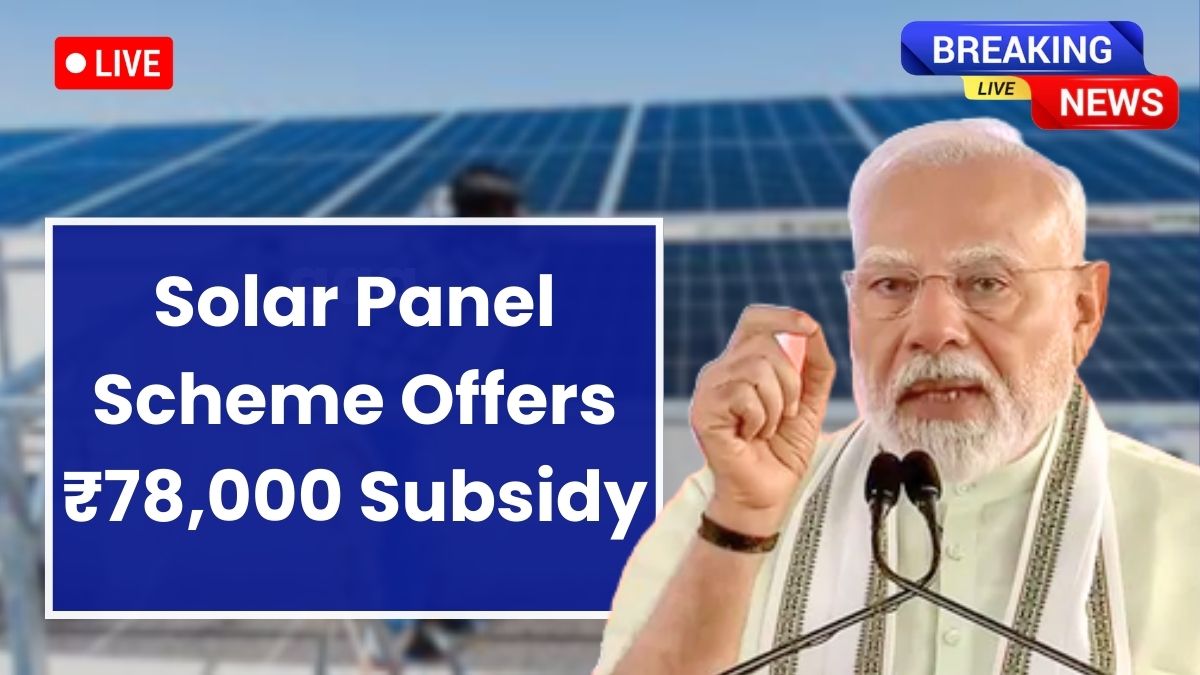
Solar Panel Scheme : Solar Panel Scheme 2026 is one of those government initiatives that can genuinely help families cut down their electricity bills while also doing something good for the environment. Under this rooftop solar subsidy plan, the government is offering financial support of up to ₹78,000 for installing solar panels on your house roof. That’s a pretty big relief considering how expensive electricity has become lately.
What is the Solar Rooftop Subsidy Scheme all about?
This scheme is run by the Ministry of New and Renewable Energy (MNRE). The idea is simple: encourage people to produce their own electricity using sunlight. Instead of depending only on traditional power sources, homes can generate clean energy right from their rooftops. The government supports this by giving a subsidy that reduces the total installation cost. The long-term goal is energy independence for households and less pollution for the country.
Why this scheme matters for common households
Electricity bills are rising every year, and for middle-class families, that monthly bill can really pinch. On top of that, coal-based electricity harms the environment. Solar energy solves both problems. Once you install a solar system, you start producing your own power during the day, which directly reduces how much electricity you draw from the grid. Over time, this can save a significant amount of money. That’s why the government is pushing rooftop solar in a big way.

Quick overview of Solar Panel Scheme 2026
This is a central government-backed scheme for residential users. The subsidy depends on how big a solar system you install on your roof. Systems are usually measured in kilowatts (kW). The common residential sizes supported under the scheme are 1 kW, 2 kW, and 3 kW. The bigger the system, the higher the subsidy, up to a maximum of ₹78,000. The entire process, from application to approval, is designed to be done online for convenience.
Subsidy amount based on solar panel capacity
The financial help you get depends on the capacity of the solar panels you install. For a 1 kW rooftop solar system, the subsidy can go up to around ₹30,000. If you install a 2 kW system, you may receive up to ₹60,000. For a 3 kW system, which suits a medium-sized household, the subsidy can reach up to ₹78,000. This amount is usually transferred directly to your bank account after installation and verification, which keeps the process transparent.
Major benefits of installing rooftop solar panels
The most obvious benefit is a sharp drop in your electricity bill. Once your panels start generating power, your dependence on grid electricity goes down. Another big plus is that solar energy is clean and renewable, so you are reducing your carbon footprint. The government subsidy makes the initial investment much more affordable. Also, solar panels are a long-term solution. A good system can last 20 to 25 years with basic maintenance, which means years of savings after the initial setup.
यह भी पढ़े:
 Pension Calculation After 15 Years Service Explained for Employees EPFO Pension 2026 Update
Who is eligible for the Solar Rooftop Subsidy Scheme
To apply, you must be an Indian citizen and at least 18 years old. The house where the panels will be installed should either be owned by you or you should have legal rights to use the roof. The system should use approved, India-made solar components as per scheme guidelines. In many cases, priority is given to residential users, especially from middle- and lower-income groups. You also need to have a valid electricity connection in your name for the property.
Documents required for the application
You’ll need some basic documents while applying. These usually include your Aadhaar card for identity, a recent electricity bill to show your consumer number and connection details, and bank account information for receiving the subsidy. You may also be asked for a passport-size photo and a mobile number for communication. In some cases, income-related documents or a declaration form may be required, depending on local rules and DISCOM requirements.
How to apply online for the solar subsidy
The application process is kept online to make things easier. First, you need to visit the official national rooftop solar portal or the MNRE-linked platform used for residential solar applications. There, you register using your mobile number, state, and electricity consumer details. After registration, you fill out the application form with your address, system capacity you plan to install, and other required details. You then upload scanned copies of the necessary documents. Once submitted, you get a registration or application number that you can use to track the status.
यह भी पढ़े:
 Big Relief for Elderly Citizens as Government Introduces New Senior Citizen Card Benefits
What happens after you apply
After your application is submitted, the local electricity distribution company (DISCOM) usually reviews it. They may check whether your roof is suitable and whether the proposed system size matches your electricity usage. Once approved, you can install the solar system through an approved vendor. After installation, there is a final inspection and net meter setup (if applicable). When everything is verified, the subsidy amount is processed and transferred to your bank account.
Long-term value of going solar at home
Think of rooftop solar as a one-time investment that keeps giving returns for decades. Besides saving money, you also get some protection from future electricity tariff hikes. In some setups, if you generate extra power, it can be sent back to the grid through net metering, further adjusting your bill. Plus, homes with solar systems are often seen as more modern and energy-efficient, which can even add to property value in the long run.
Final thoughts on Solar Panel Scheme 2026
If you have a decent amount of free roof space and a regular electricity bill, this scheme is definitely worth considering. The ₹78,000 subsidy can make a big difference in reducing the upfront cost. Over time, the savings on electricity can recover your remaining investment and then continue to benefit you for many years. It’s a practical step toward lower bills, cleaner energy, and a bit more financial control at home.

Disclaimer: This article is for general informational purposes only and is based on publicly discussed government rooftop solar subsidy programs. Scheme details, subsidy amounts, eligibility, and processes may change over time and can vary by state and electricity distribution company. Readers are advised to verify the latest official guidelines on the government’s renewable energy or rooftop solar portal and consult authorized vendors or local DISCOM offices before making any financial or installation decisions.